In today’s business environment, where sustainability and resource optimization are integral to corporate strategy, reverse logistics has become a key factor in supply chain management. Returning packaging for reuse enables cost savings, environmental protection, and improved transport processes. However, one of the main challenges in reverse logistics is the ability to operate a large-scale collection network – something traditional logistics systems are not always built to handle.
The Difference Between Traditional and Reverse Logistics
Traditional logistics systems are often based on the Cross-Docking process – moving products from supplier to customer with minimal time in distribution centers. The focus is on moving goods forward quickly and efficiently.
Reverse logistics, on the other hand, works in the opposite direction: collecting packaging from multiple points across various countries and regions, returning it to maintenance centers, and then preparing it for reuse. This means managing equipment flow in reverse, under changing conditions and with irregular collection volumes.
The Challenge of High-Volume Collection
In large-scale packaging return operations, coordination is required between multiple stakeholders – customers, storage centers, transport companies, and maintenance teams. In some cases, collection is carried out from remote locations or from points without consistent return volumes.
To ensure high-volume returns, the system must meet several requirements:
- Operational flexibility – adapting transport capacity to fluctuating demand.
- International coordination – working with multiple freight forwarders and customs brokers.
- High capacity in maintenance centers – receiving, sorting, and repairing packaging at scale.
The EcoHandling Solution
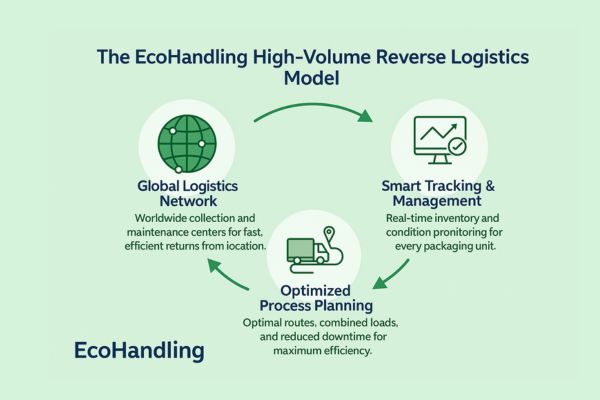
EcoHandling, which manages the logistics system for reusable packaging, has developed a unique model for handling large-scale reverse logistics. The model is built on three key elements:
- A global logistics network – partnerships with collection and maintenance centers worldwide, enabling fast and efficient returns from any location.
- Tracking and management technologies – real-time inventory systems for shipment coordination and monitoring the condition of every unit.
- Smart process planning – building optimal collection routes, combining loads from different customers, and reducing downtime for packaging assets.
Advantages of the Model
Through targeted logistics management, EcoHandling is able to:
- Shorten return cycle times.
- Maximize the number of units returned per cycle.
- Maintain packaging quality so it is ready for immediate reuse.
Conclusion
High-volume packaging returns are a complex task that require coordination, control, and execution at the highest level. EcoHandling’s logistics model offers a complete solution to this challenge, combining advanced operational capabilities, smart technology, and a broad global network – ensuring customers receive reliable, fast, and fully tailored service for the modern business landscape.