
The international transport of a turbine weighing approximately 50 tons and measuring nearly 10 meters in length is far from a routine logistics task. It is a complex operation that combines engineering, operations, safety, and long-term planning. Beyond the exceptional weight and dimensions, this is sensitive infrastructure equipment that must return to Israel after maintenance in a precise mechanical condition, ready for reinstallation and renewed operation.
In this context, packaging and transport are not secondary stages that follow engineering—they are a direct continuation of it. Every decision regarding packaging methods, materials, and fixation directly affects the integrity of the equipment, the continuity of the process, and the ability to complete a full round trip without incidents.
Packaging as an Extension of Engineering
The turbine itself was enclosed and protected using aluminum, providing direct protection for the sensitive component. Around this enclosure, a packaging solution was required to deliver structural, logistical, and operational support without adding unnecessary complexity.
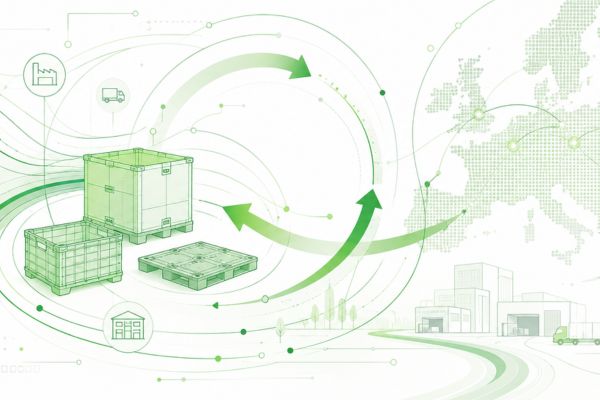
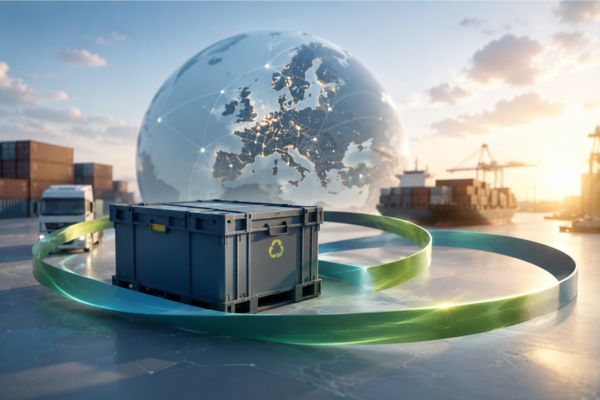
This is where EcoBox was integrated into the project. EcoBox is a modular, reusable packaging system designed to work in conjunction with the dedicated transport base on which the turbine was mounted. In this case, EcoBox was not used as a sealed enclosure, but as a supporting structural and logistical framework—maintaining the integrity of the overall assembly, protecting against external impacts during transport, and enabling organized handling throughout the project lifecycle.
The choice of EcoBox allowed precise integration between the packaging system and the transport base, enabling both to function as a single, coherent unit. This represents a fundamental difference between a simple external cover and a packaging solution that is engineered as part of the transport system itself.
Challenges of International Transport
Transporting a heavy turbine from Israel to France involves multiple stages: inland transport to the port, loading operations, maritime transport, unloading, interim storage, and additional transport to the maintenance facility. Each stage introduces different risks—shocks, vibration, changes in orientation, weather exposure, and extended idle periods.
The packaging system was required to address all of these challenges without compromising the turbine’s mechanical precision. EcoBox, as a rigid and modular solution, enabled controlled fixation of the assembly, preservation of consistent geometry, and long-term durability—even when the equipment was stationary for extended periods in ports or intermediate storage sites.
Field Execution in an Active Infrastructure Environment
The packaging process was carried out within an active power infrastructure facility, under strict safety constraints, time pressures, and coordination with multiple stakeholders. This was not a controlled warehouse environment, but an operational site where every action required careful planning and compliance with safety and operational protocols.
The work involved skilled packaging teams and heavy lifting equipment, adapted to real field conditions. Packaging was not treated as a one-time task, but as part of an ongoing process that required operational flexibility and the ability to respond to changes in real time.
Designing for Reuse and the Return Journey
A key principle of the project was planning in advance for the return journey from France to Israel. As a reusable packaging system, EcoBox enabled the same packaging framework to be used again, eliminating the need for new packaging materials or improvised solutions during the return phase.
This approach delivers more than cost and time savings—it significantly reduces risk. Reusing a packaging system that has already been proven during the outbound journey minimizes uncertainty and provides greater control over the process.
Packaging as Part of the Operational Value Chain
In projects of this nature, packaging is not a peripheral layer that can be overlooked. It is an integral part of the operational value chain. Proper packaging protects the investment, reduces downtime, and enables faster return to service following maintenance.
EcoBox demonstrates this approach in practice: a reusable packaging solution engineered to integrate with transport and handling systems, supporting the management of critical infrastructure equipment throughout its entire lifecycle.
A Broader Perspective
The transport of a 50-ton turbine for international maintenance illustrates how intelligent packaging, early planning, and system-level thinking create a safe, efficient, and responsible process. When packaging is designed as an integral component of the transport system—rather than a temporary add-on—it becomes possible to meet the most demanding challenges of national infrastructure projects.