In today’s global reality—characterized by resource shortages, supply chain volatility, and growing environmental regulations—logistics is no longer a supporting function. It’s a strategic lever that can shape an organization’s future. Among the most impactful and innovative solutions in this space are Take-Back systems—structured logistics processes that enable packaging and products to be returned from the end user back into the supply chain for reuse, maintenance, recycling, or smart resource management.
At EcoHandling, we specialize in the design, implementation, and management of advanced Take-Back systems that empower our clients to improve operational efficiency, reduce dependence on virgin materials, and embed sustainability into their logistics operations.
The Principle Behind the System – A Smart and Closed Logistics Loop
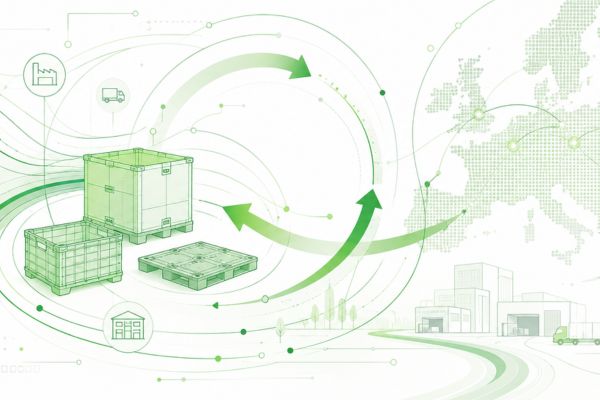
A Take-Back system is built on a simple yet powerful concept: the product or packaging doesn’t end its life with the customer—it continues to circulate within a closed logistics loop. Instead of being treated as a one-time-use item, the packaging is designed to return, regenerate, and reenter the flow.
The process includes:
• Collection of packaging and products from the customer
• Sorting and condition assessment
• Repair, sanitization, or refurbishment
• Transport to a central logistics hub
• Preparation for reuse in the next cycle
This system minimizes the need for new materials, reduces waste, and optimizes the efficiency of the entire supply chain.
Forward Logistics vs. Reverse Logistics – A Different Process, Unique Challenges
Forward logistics focuses on outbound movement—from supplier to customer—with emphasis on speed, delivery times, and shipping costs. Reverse logistics, on the other hand, involves the return flow—retrieving packaging, components, or products from customers back to logistics centers.
This process requires tighter coordination and refined planning. Unlike forward shipments, returns are not always standardized. They demand a more collaborative, real-time interface between sender and receiver, as well as a structured system for product identification, tracking, and handling.
When managing global Take-Back processes, complexity increases significantly. Organizations must rely on a broad international logistics network capable of operating across languages, handling local payments in multiple currencies, and complying with various regional regulations. Moreover, collection coordination requires close monitoring of each shipment and precise scheduling, ensuring materials are retrieved on time and reintegrated into the system efficiently.
At Ecohandling, we have developed global collection capabilities and advanced monitoring systems that turn reverse logistics from a fragmented challenge into a well-orchestrated process that delivers business value.
Automating the Return Process – Speed, Accuracy, and Greater ROI
As Take-Back systems become a core element of supply chain strategy, automation and digital process control are key to achieving performance at scale. Our systems incorporate:
• Barcode and RFID-based product identification
• Real-time inventory tracking
• Automated sorting based on type, condition, or destination
• Seamless integration with ERP and WMS platforms
Automating the return process minimizes human error, reduces processing times, and accelerates the return-to-use cycle—ultimately increasing the return on investment from reusable packaging systems.
Building Interfaces Between Suppliers, Customers, and Logistics Centers
A successful Take-Back system is not just about transport—it’s about relationships. Its success depends on building robust operational interfaces among suppliers, customers, and logistics hubs, including:
• Clearly defined return processes
• Designated and accessible collection points
• Coordinated scheduling and real-time data sharing
• Full process transparency
At Ecohandling, we help our clients create seamless integration between all supply chain stakeholders, ensuring the system functions smoothly, predictably, and efficiently.
Ecohandling’s Expertise – From Logistics Process to Strategic Platform
What sets Ecohandling apart is our ability to deliver end-to-end solutions:
• Customized process planning and system design
• Integration of durable, reusable packaging solutions (e.g., EcoBox)
• Full-scale reverse logistics operations and maintenance
• Data-driven performance analysis and continuous improvement
Our Take-Back systems generate measurable value through cost reduction, enhanced service quality, waste minimization, and improved ESG performance.
In Conclusion – Reverse Logistics Is the Start of Something Better
In a world of constrained resources and rising operational demands, Take-Back systems are no longer optional—they are essential. They transform logistics into a hub of innovation, sustainability, and business efficiency.
At EcoHandling, we help organizations rethink logistics—not as a linear process, but as a dynamic, circular engine for long-term success.