Large and heavy printing machines are among the most valuable assets in any production facility. They are designed to operate under high workloads, and their sensitive construction demands precise care even during transport. Any damage along the way – moisture penetration, corrosion, or mechanical shocks – can result in tens of thousands of euros in repair costs and delays across the supply chain. Packaging, therefore, is not a secondary concern but a strategic component of every shipping project.
The Problem with Single-Use Packaging
Traditional wooden packaging has long been used for heavy printing machines. The bigger and heavier the machine, the more wood, disposable metals, and reinforcements are required – and all of it ends up as waste after a single journey.
The larger the machine, the greater the economic and environmental damage caused by destroying the packaging.
- Direct costs: thousands of euros per shipment wasted on disposable packaging.
- Environmental costs: deforestation, consumption of raw materials, and large amounts of waste at customer sites.
- Indirect costs: reputational damage when end customers expect sustainable practices.
EcoBox as a Packaging Solution
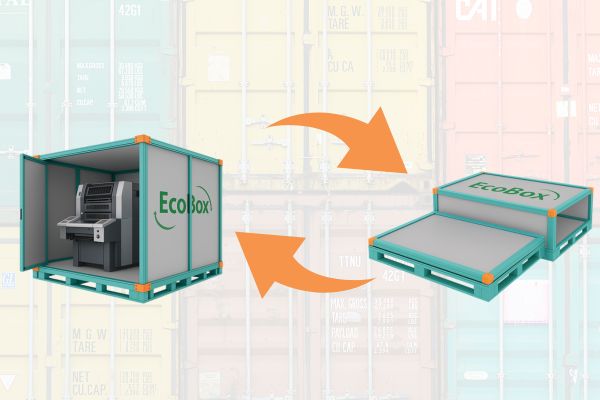
EcoBox provides a fundamentally different approach:
- Reusable metal base – engineered to carry loads of dozens of tons, ensuring full stability even during long sea voyages.
- Polypropylene plastic walls – lightweight, flexible, resistant to direct sunlight, and combining protective strength with operational efficiency.
- Brackets and fittings – reused shipment after shipment instead of being discarded.
In this way, packaging shifts from a disposable expense to a reusable logistics asset that serves equipment over many years.
Real Cost Savings
Using EcoBox packaging generates savings on several levels:
- Lower material costs – no need to build expensive wooden packaging for every shipment.
- Equipment protection – reduced risk of damage avoids repairs and downtime.
- Reusable cycles – the initial investment is spread across many shipments.
The savings are both direct and indirect, creating financial efficiency while also supporting operational continuity and brand credibility.
EcoHandling – Reverse Logistics in Action
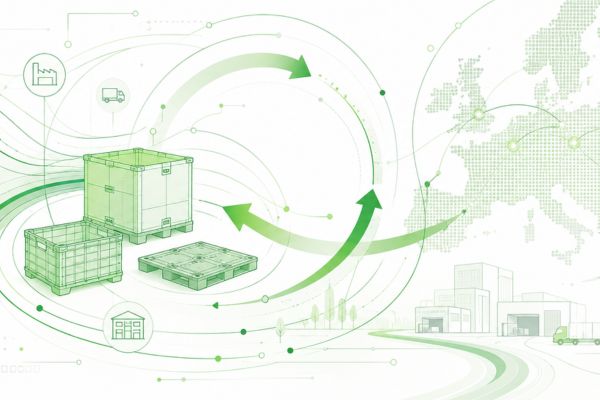
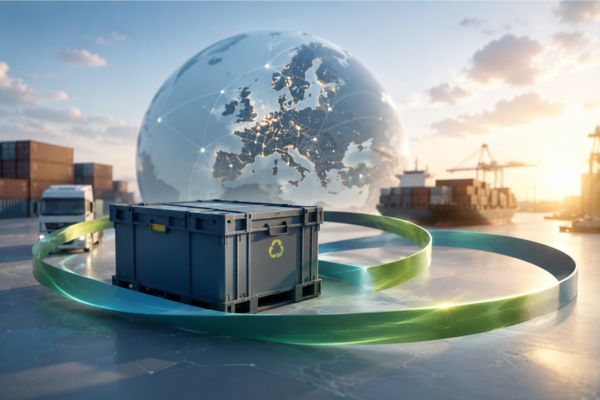
For EcoBox packaging to deliver its value consistently, it must be supported by a global logistics framework. EcoHandling provides exactly that, using EcoBox as the right packaging solution for the printing industry:
- Collects EcoBox units from any global destination.
- Maintains and refurbishes the bases and walls for reuse.
- Integrates EcoBox into the logistics cycle so that return, maintenance, and preparation for the next shipment are part of one seamless process.
This makes reverse logistics not a separate function but an integral part of the packaging solution for the printing sector.
Environmental and Operational Value
EcoBox reduces the reliance on wood and other disposable raw materials:
- Less waste at customer sites.
- Lower environmental impact through reuse.
- Positive sustainability image that directly strengthens customer trust and long-term relationships.
At the same time, operational value is achieved: stable workflows, reduced risks of equipment damage, and assurance of delivery quality from start to finish.
Conclusion
The return on investment in packaging for printing machinery is measured not only in euros saved, but also in production continuity, customer trust, and environmental responsibility. EcoBox, as a modular and reusable packaging solution, reduces costs and protects valuable equipment. EcoHandling ensures that EcoBox units are fully integrated into reverse logistics worldwide – from design to manufacturing, collection, and reuse – so that every machine arrives safely, while the packaging itself continues to serve shipment after shipment.
The EcoBox design teams are ready for any project and challenge, delivering complete solutions – from engineering adaptations to intelligent logistics. Packaging thus moves from being a burden to a clear business advantage.