In today’s global supply chains, packaging is often treated as a technical necessity rather than a strategic lever. However, organizations managing complex logistics — especially those handling both components and heavy equipment — face a broader opportunity.
Internal (inbound) and external (outbound or project-based) packaging are often approached as separate operational challenges. Yet in reality, they exist within the same supply chain ecosystem and must be managed as parts of a single, integrated system.
Organizations that recognize this connection — and adopt solutions that support both worlds under one unified approach — are able to improve efficiency, reduce risk, and unlock significant operational value.
Two Operational Worlds – One Integrated System
At a high level, supply chains operate across two distinct packaging environments — internal and external. Each presents different characteristics, constraints, and requirements.
Internal packaging focuses on components moving through predictable flows. These shipments typically originate from fixed suppliers, follow known routes, and are tightly integrated into production processes.
External packaging, in contrast, deals with heavy machinery and project-based logistics. Shipments are often high-value, collected from varying locations, and transported under changing conditions.
While these environments differ significantly, they are not disconnected. Both are part of the same operational reality — and both must be supported within a coordinated system.
A unified approach enables organizations to maintain efficiency in stable flows while effectively managing variability in complex, project-driven logistics.
Internal Packaging: Standardization Within a Broader System
Internal logistics environments benefit from consistency. Working with fixed suppliers enables the development of standardized, reusable packaging solutions that become embedded within daily operations.
These packaging systems are designed to be modular, durable, and easy to handle. Over time, they create a stable infrastructure that supports efficiency and scalability.
Within a unified system, internal packaging plays a critical role. It provides the foundation of predictability — enabling smooth flow, reduced handling complexity, and lower operational costs.
Rather than operating in isolation, internal packaging becomes one pillar of a larger, coordinated packaging strategy.
External Packaging: Engineered Solutions for Complex Conditions
External packaging operates under more variable and demanding conditions. Heavy equipment shipments require robust protection and must withstand diverse transport environments, including maritime and multimodal logistics.
In addition, collection points, routes, and timing often change from one shipment to another. This variability introduces complexity that cannot be addressed through standardization alone.
Within an integrated system, external packaging is approached as an engineering discipline. Solutions are designed to handle a wide range of conditions while maintaining reliability and performance.
By applying structured design and planning, organizations can create consistency even in unpredictable environments — aligning external operations with the broader system.
Reverse Logistics as the Connector – The EcoHandling Advantage
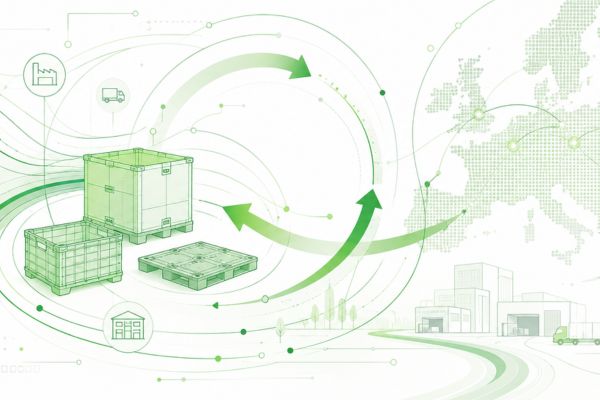
The true power of a unified packaging system lies in its ability to connect internal efficiency with external complexity.
Reusable packaging, whether used in internal flows or external projects, only delivers full value when it can be effectively returned, tracked, and redeployed.
Reverse logistics is therefore not just a supporting function — it is the mechanism that links both worlds into one continuous system.
This is where EcoHandling creates a distinct advantage.
By combining expertise in standardized internal packaging, engineered solutions for external logistics, and global reverse logistics capabilities, EcoHandling enables organizations to manage both environments under one coordinated framework.
Packaging assets are not treated as one-time solutions, but as controlled, reusable resources that move across the entire supply chain — from suppliers, through operations, to global destinations and back again.
This end-to-end visibility and control transforms packaging into a strategic asset.
When internal standardization, engineered external solutions, and integrated reverse logistics are managed together, organizations achieve more than operational efficiency. They create a resilient, scalable system that supports long-term performance and continuous improvement.